Introduction
The questions that dominate crypto conference discussions — how do you establish trust in a trustless system, what does a verifiable licence actually prove, how do smart contracts change accountability — don’t disappear when you move from decentralized finance into consumer gaming. They become more visible, because the stakes are immediate and personal.
Crypto casinos sit at an intersection that anyone following the fintech and blockchain space should find genuinely interesting. They depend on the same cryptographic infrastructure that underlies the broader digital asset ecosystem. They raise the same unresolved questions about decentralization, consumer protection, and what “trust” actually means when an intermediary is involved. And they surface a problem that conference panels debate constantly: what happens when the technical architecture is sound but the operator behavior is not.
For Canadian players specifically, the landscape in 2026 is more complex than most markets. Ontario and Alberta now operate regulated iGaming frameworks. Ontario explicitly bans cryptocurrency within its licensed market, which means most crypto casinos function as offshore operators in the province’s grey zone. Understanding how to evaluate these platforms draws on the same critical thinking that makes a blockchain developer, fintech analyst, or crypto investor effective in their professional work — verifying what can be verified, treating marketing claims as hypotheses rather than facts, and understanding what a licence actually grants and what it doesn’t.
This article examines the crypto casino landscape for Canadian players through that lens: what the technical and operational infrastructure signals about trust, which platforms demonstrate it, and how to think about this category using the same analytical standards you’d apply to any digital financial system.
What Blockchain Infrastructure Actually Tells You About a Crypto Casino
Licence Verifiability Is the Baseline
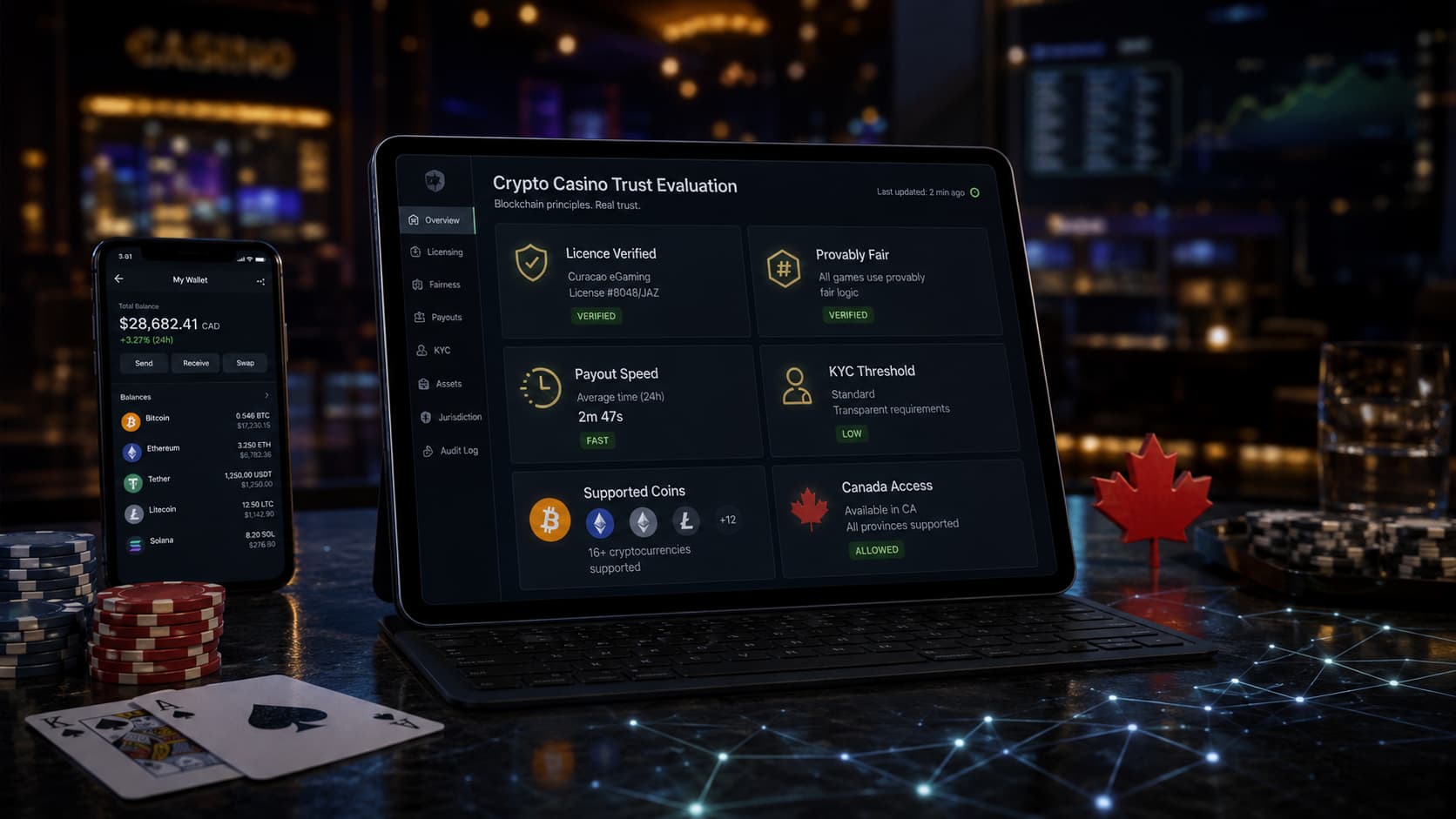
A Curaçao GCB licence is searchable. A Kahnawake Gaming Commission licence is publicly listed. These aren’t strong consumer protections by the standards of a regulated banking system, but they’re a baseline — a verifiable claim that can be confirmed independently. An operator that claims licensing but provides no verifiable registration number is making an unverifiable assertion, and in any digital trust system, unverifiable claims are a red flag rather than a green light.
The quality of the licence matters too. The Curaçao framework has operated since 1993 and has published complaints processes. Kahnawake has its own dispute resolution mechanism. Neither provides the same consumer protection as Ontario’s AGCO-registered operators, but the difference between a verifiable offshore licence and no verifiable licence at all is meaningful. It’s the same distinction between a DEX with open-source, audited smart contracts and one whose code is closed and unverified — you can’t confirm what you can’t inspect.
Provably Fair Gaming Is Cryptographic Transparency Applied
Provably fair games use a mechanism that blockchain practitioners immediately recognize: commitment schemes. Before a game round begins, the server generates a server seed and publishes its hash. The player provides a client seed. After the round, both seeds are revealed and the outcome can be verified by any third party using the published hash function. This is cryptographic transparency applied to gambling outcomes — the same logic that makes blockchain transaction finality trustworthy.
Not all crypto casinos offer provably fair games, and not all games on platforms that offer them are provably fair. Slots and live dealer tables typically use RNG certificates from third parties like eCOGRA or GLI rather than on-chain verification. Both have value, but they’re different mechanisms. The former is trustless in the cryptographic sense; the latter requires trusting the auditing body. Understanding that distinction matters the same way it matters in DeFi: on-chain is different from off-chain assurance.
Payout Infrastructure Reveals Operational Integrity
The crypto rails are fast. Bitcoin typically clears in ten to thirty minutes. Litecoin and Solana clear in under ten. USDT on TRC-20 often settles in two to three minutes. If a platform claims crypto payouts and consistently takes forty-eight hours or more, the bottleneck isn’t the blockchain — it’s a manual review process, a liquidity management issue, or a deliberate gate on withdrawals. Community payout reports, cross-referenced over time, reveal the actual operational pattern rather than the marketed one.
The specific breakdown matters too. A platform that processes small withdrawals quickly but delays or disputes large ones is exhibiting a pattern that any risk analyst would flag: a system designed to be frictionless for deposit and frictional for withdrawal above a threshold. This appears in the complaint records of platforms across the industry and is one of the most reliable indicators of operational integrity problems.
KYC Architecture Reflects How the Platform Treats Users
KYC in crypto casinos isn’t optional in the way platforms sometimes imply — it’s deferred. Every platform with a legitimate licence has AML obligations, which means identity verification will trigger at some threshold. The question is where that threshold sits and whether it’s disclosed honestly.
Platforms that claim “no KYC” as a feature but quietly apply verification at large withdrawal values aren’t offering a no-KYC product — they’re deferring the friction to a point where the user has less leverage. This is the same pattern that appears in any financial service that markets accessibility but buries constraints in fine print. The more trustworthy design — and the one more consistent with the transparency principles that dominate crypto conference discussions — is a clearly disclosed tiered KYC structure: no documents below a stated threshold, verification required above it. Predictable friction is better user design than hidden friction.
Top Crypto Casino Platforms for Canadian Players: A Trust-Based Ranking
#1 — Best Crypto Casino Canada: Start With the Comparison
Before any individual operator, the first tool worth using is a rigorous comparison of the full Canadian field. Best Crypto Casino Canada has evaluated 23 operators specifically for Canadian players, with an approach that mirrors good technical due diligence: it reads each casino’s own published terms rather than relying on marketing, distinguishes what operators claim from what community reports confirm, and explicitly flags the platforms whose patterns suggest operational problems.
The comparison table is sortable by KYC threshold, payout speed, provincial access, and real bonus terms — after wagering requirements, maximum bet constraints, and game contribution rates, not before. The site also publishes an explicit list of operators it advises against, with documented reasons. That kind of editorial honesty is uncommon in an affiliate-driven category and is itself a signal worth noting.
For anyone approaching this as a research question rather than an impulse decision, the comparison resource is the right starting point.
#2 — 7Bit Casino
Overview
7Bit has been operating since 2014 and holds a verifiable Curaçao GCB licence. It prices its cashier in native CAD, requires a C$20 minimum deposit, and has accumulated one of the thinnest complaint files in the industry relative to its operational volume. These are the fundamentals that matter: track record, verifiable licensing, and demonstrated payout behavior over time rather than marketing claims.
The trust signals
A platform running since 2014 has survived multiple crypto market cycles, regulatory shifts in multiple jurisdictions, and the reputational pressure of a large, technically literate user base that actively shares withdrawal experiences in public forums. The complaint-to-volume ratio is a better signal than absolute complaint counts. 7Bit’s ratio is low. User-reported payout times cluster around eight minutes for standard withdrawals.
The terms in plain language
The welcome bonus — 325% up to C$10,800 plus 250 free spins — carries a 35x wagering requirement on bonus funds only, not the standard industry approach of applying the multiplier to deposit plus bonus combined. The C$2 maximum bet while wagering is the constraint to understand clearly: at that stake, clearing a large bonus is a time-intensive commitment. Players who prefer to manage this simply can decline the bonus and play with their deposit only — that option is always available and sometimes the better choice.
Provincial note
Ontario players have no AGCO consumer protection here. 7Bit and its sister platform mBit share a parent company and a Curaçao licence — the operational risk is the same entity.
#3 — BitStarz
Overview
BitStarz’s most distinctive feature from a terms-verification standpoint is straightforward: its terms explicitly do not restrict Canadian players anywhere in the document. Most offshore casinos are either silent on Canada or restrict specific provinces without acknowledging it clearly. BitStarz names it. For players who want to verify counterparty terms before committing funds, explicit language is better than silence.
The infrastructure angle
BitStarz also operates a hybrid cashier — crypto alongside Interac and iDebit for Canadian players. This is relevant for anyone who holds CAD fiat and wants direct access without routing through an exchange. The platform has been running since 2014 alongside 7Bit, providing a comparable track record. User-reported crypto payout times run around nine to eleven minutes.
The terms in plain language
The 40x wagering requirement applies to deposit plus bonus combined — harder to clear than 7Bit’s bonus-only structure at 35x. Live dealer and table games contribute at 5%, which effectively excludes those game types from efficient bonus clearing. Players whose primary game preference is table or live games should factor this into the bonus decision.
#4 — wild.io
Overview
wild.io’s claim to distinction is documented payout speed: an independently conducted test clocked average withdrawal times around six minutes, the fastest tested result in the current Canadian comparison field. In a category where payout speed claims are common and often unverified, a tested figure from a documented methodology carries more weight than a marketing assertion.
The operational design
The platform uses a discretionary KYC approach — withdrawals under approximately C$1,000 are consistently processed in user reports without documentation requests. The daily rakeback and weekly cashback structure (up to 20%) creates an ongoing value mechanism that distributes benefit across the relationship rather than front-loading it in a single welcome offer that may be difficult to clear.
Provincial note
Ontario is reported as geo-blocked. The crypto-only cashier means Canadian players need to use the Interac-to-exchange path before depositing — a straightforward process but one that requires fifteen minutes of setup on a first use.
#5 — Cloudbet
Overview
Cloudbet has been running since 2013 — one of the longer-tenured operators in the crypto gambling space — and operates a genuine sportsbook alongside its casino. For Canadian players interested in NHL coverage alongside casino gaming, the depth of the sports product is meaningfully different from the token sports sections that most casino-primary platforms attach.
The technical design
Cloudbet supports 29 coins with CAD as a first-class account currency and no minimum deposit requirement. Its KYC architecture is tiered and disclosed — players can start without documentation and unlock higher limits by verifying incrementally. This is a more honest design than platforms that claim no-KYC and apply it selectively. One documented case of a ten-day review on a large withdrawal exists in community records, which is worth knowing for anyone planning to play at meaningful stakes.
The welcome structure
The $2,500 welcome package releases through loyalty play rather than depositing immediately, which is structurally different from a standard match bonus. This is worth understanding before signing up — it’s not a worse design, but it’s a different one, and the difference matters for how you plan your first deposit.
#6 — mBit Casino
Overview
mBit operates as a crypto-only platform with a default no-KYC approach up to approximately 1 BTC in cumulative withdrawals. For players who specifically value keeping gambling activity separate from identity documentation, this is a feature with genuine practical value. The shared infrastructure with 7Bit means the operational track record is similar in character.
The constraint to know
The bonus terms are the sharpest constraint on this platform: 40x wagering, slots only, with a one-day validity window. The time constraint is the most operationally significant — any bonus funds not cleared within the session that started them expire. Players who prefer to spread play across multiple shorter sessions will find this structure conflicts with how they like to play. Skipping the bonus and playing deposit-only is a legitimate option that resolves this entirely.
#7 — JackpotCity (Ontario and Regulated Access)
Overview
JackpotCity holds an AGCO-registered licence for Ontario — the only option on this list where Ontario residents have access to provincial consumer protection, regulated dispute resolution, and the same accountability framework that governs any licensed Ontario gambling operator. For players who weight regulatory recourse above transaction speed, this is a categorically different product from the offshore options.
The trade-off
Ontario’s regulated framework explicitly prohibits cryptocurrency within licensed operations. JackpotCity operates on Interac and card banking for Ontario players. Payouts run on banking timelines (one to three business days for Interac) rather than blockchain speed. For players outside Ontario, the .com site accepts crypto deposits alongside conventional banking.
The regulated vs. offshore question ultimately comes down to what you’re optimizing for: maximum transaction efficiency and privacy, or verified consumer rights and dispute resolution. These are genuinely different products that serve different priorities. Neither is the wrong answer if chosen with full information.

Applying Conference-Grade Thinking to Platform Selection
The same evaluation framework that makes a fintech professional effective at assessing a new protocol or exchange applies directly to crypto casino selection. A few practical principles:
Verify the licence, don’t just accept the claim. Curaçao GCB and Kahnawake are searchable databases. If a platform says it’s licensed, look up the registration number. If it doesn’t publish one, treat the claim as unverified.
Read the complaint record, not just the review score. Aggregated star ratings smooth over the patterns that matter most. The most revealing complaints are not about a bad experience on a single game — they’re about withdrawal delays that appear specifically after large wins, or KYC requests that appear specifically when a payout would be material to the operator. These patterns are visible in community forums and complaint databases if you look at the detail rather than the average.
Treat the wagering clause as the real price of the bonus. The bonus headline is an acquisition cost presented as generosity. The wagering requirement is the actual cost structure. A 40x requirement on deposit plus bonus is significantly harder to clear than a 35x requirement on bonus only, even though both have similar-looking headline numbers. The Kahnawake Gaming Commission publishes its regulatory standards and player rights framework, which provides useful context for understanding what an offshore licence actually requires of operators.
Match your coin choice to your actual objective. Bitcoin is maximally decentralized and maximally established, but slower and more expensive per transaction than alternatives. Litecoin and Solana offer fast, cheap settlement for players whose primary concern is efficient deposits and withdrawals. USDT on TRC-20 provides stable purchasing power if you want your entertainment budget to hold its dollar value between sessions. These aren’t equivalent choices — they’re different tools for different priorities.
Use the comparison resource before any individual platform. The full field comparison at Best Crypto Casino Canada is the most rigorous Canadian-specific resource available on this topic. It covers the provincial access, KYC, bonus terms, and payout reality across all 23 operators in the comparison set, and it identifies the platforms it advises against alongside the ones it recommends. That combination is rarer than it should be.
[For more coverage of blockchain infrastructure, crypto tools, and digital finance developments, explore the related articles in the DARB Finance news section.]
Disclaimer: Gambling involves financial risk and is for adults of legal age only — 19+ in most Canadian provinces, 18+ in Alberta, Manitoba, and Quebec. Offshore crypto casinos operate outside provincial consumer protection frameworks. Ontario’s AGCO-regulated market prohibits cryptocurrency within licensed operations; most crypto casinos are not registered with AGCO. Nothing in this article constitutes legal, financial, or tax advice. For responsible gambling support in Canada: ConnexOntario 1-866-531-2600 or the Responsible Gambling Council at responsiblegambling.org.
About the author: Written by a Canadian crypto and fintech writer with a background in blockchain infrastructure and digital finance analysis